
Father, Son, and Holy Spirit. We accept that. Mind, Body and Soul. Also easily agreed to. Worship, Study and . . . something is missing. One leg missing on what should be a three legged chair. We worship Him, study the bible but the body is treated like an evil thing. That can’t be right.
Somehow, in two millennia, the earth became an enemy to be conquered. The land betrayed us. Along with that, our bodies became shitting, puking, too often sick, temptations that pulled us away from holiness. We are cursed with this needy ambulatory meat brain bucket. All the Maslow hierarchy stuff betrays us.
Is this so? God created the heavens and the earth and called it good. He made Adam and gave him dominion over the heavens and the earth. Yeah. Eve. Because Adam needed help. No, I don’t agree that she is to blame. The whole Eve thing is complicated. It’s not until the Protestant Reformation that our neurosis over our bodies becomes viral.

We Are Three, Not Two
Mind, soul and one more thing. What was it? We worship His Word. We try to feed the God sized hole in us with prayer. ADD break. The trinitarian fight. Leave me alone. The Nicene Council planted their flag on a trinitarian God. My church is Presbyterian. We worship a trinitarian God. Fight me. I don’t care.
My axe to grind in these 1500 words isn’t whether God is three in one or just one. It is the something that happened to us in the fight with the Catholic church over indulgences and other doctrine that us, the Protestants, found to be non-biblical. We forgot our bodies and the world we live in.
God made Adam then decided he needed Eve. Adam and Eve he created them. So these two were made flesh. And given the earth to live in, also to have dominion over it. So if our world and our bodies are evil sources of sin and temptation are we saying God isn’t God but a temptress? He made a dissonant creation to . . . what? That doesn’t make sense.
Fat, Sick and Sick of Being Fat and Sick
Most of the maladies of adults are traceable to lifestyle. Most of human history farm-to-table was how we survived. Adam and Eve became farmers once they were banished from the Garden of Eden. IMHO, agrarian life is a step up from hunter/gatherer. I’m not sure the pastoral utopian depictions of Eden would be that much better. A good farmer’s wife can find eggs in the chicken coop. A hunter has to find the nests.
We eat manufactured food. By the time we pick the chicken thighs from the display case at the supermarket there is an entire chain of poultry farmers, butchers, transportation, inspection, packaging, and more that got the chicken thighs to the display case. Is that bad? No. But something gets lost in all that industrial machinery.
We exercise in manufactured facilities dedicated to working out. Because we don’t work the land. So we invented treadmills that let us walk to nowhere with a bank of television screens broadcasting banalities. Ask us to walk beside a trailer and throw hay bales on it and we exhaust ourselves with the first bale. About 43% of us are obese. Vietnam is at the other end with about 2.1% The difference?
| Country Type | Estimated Adult Obesity Rate | Notes |
|---|---|---|
| United States | ~43% | High-income, sedentary, processed food dominant |
| Nigeria | ~11% | Agrarian, but urbanization is increasing obesity |
| Kenya | ~11% | Rural majority, low processed food access |
| Ethiopia | ~2.4% | One of the lowest globally; subsistence farming |
| Vietnam | ~2.1% | Agrarian, traditional diet, high physical activity |
Calvin Sawed Off the Third Leg
The differences are diet and exercise. Whyzzat? We eat too much crap. And we think of sedentary living as luxury. The Vietnamese are agrarian with a traditional diet and high physical activity. Vietnam’s lifestyle, though not perfect, still honors the body through rhythm, restraint, and relationship. The U.S., by contrast, commodifies the body, isolates it, and then blames it.
Calvin, near-saint of the Reformed tradition, saw the body as a dim mirror of divine image—its sparks flickering before the fall, then fading into fleshly distraction. “Although the primary seat of the divine image was in the mind and heart, or in the soul and its powers,” he wrote, “yet there was no part of man, not even the body itself, in which some sparks of God’s image did not glow.” But those sparks, in Calvin’s framing, were residual—faint embers from a prelapsarian fire. The body became a site of temptation, weakness, and distraction from grace.
The U.S. commodifies the body. It isolates it and blames it. We treat sedentary living as luxury, processed food as reward, and shame as discipline. Vietnam, by contrast, still honors the body through rhythm, restraint, and relationship. Agrarian life, traditional diet, and communal movement preserve a kind of embodied dignity.
Our three-legged stool—mind, body, spirit—has one leg missing. And Calvin, for all his brilliance, helped saw it off.
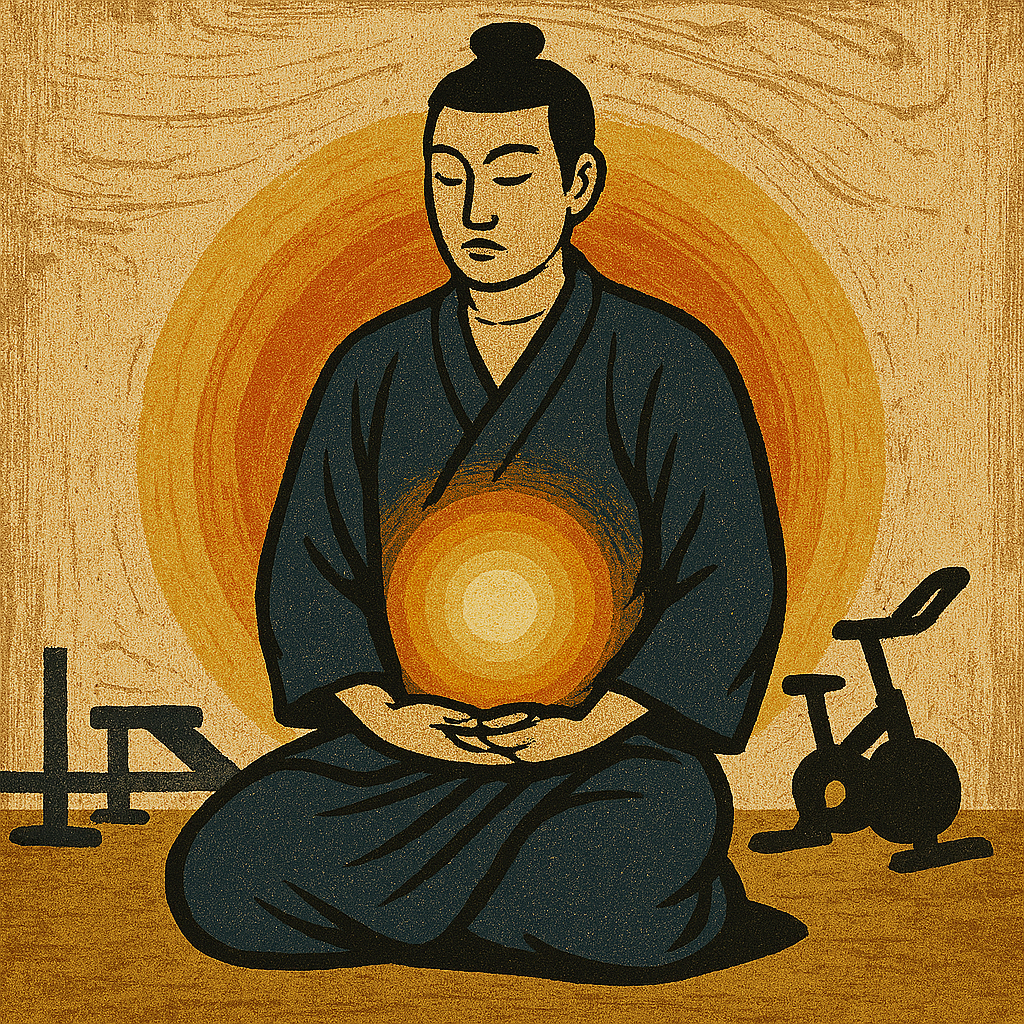
Where Is Christ in the Body?
So Calvin cut off the third leg. And centuries later its absence is carved in stone. Nobody dares touch his amputating words. The body is still a site of temptation and weakness distracting us from grace. Holiness is cerebral, spirit housed in our hearts. Locating Christ at our center of gravity seems suspiciously Hindu.
My pastor, on hearing my suggestion that we are missing one leg of a three legged stool, started sputtering about heresy. Ok. That terrible stone mason from Nazareth uttered blasphemy two millennia ago. His words spoke truth to power and he was martyred for it. We have some history with scandalous words that turn out to be things God wants us to hear.
It’s not news to me that our discipleship is wobbly and incomplete. We moved Jesus out of His natural place at a point roughly 9cm below our navels to safe confinement in our intellect. Our charismatic brethren took a chance on giving him a vacation home in our hearts . . . but only temporarily and only if the music was loud and passionate.
Gratia incarnata
Incarnate discipleship is a thing. But the common thing is missions, service and demonstrative prayer. Speaking in tongues is cited as incarnate faith. But I wonder . . . does incarnate faith have to be visible to those around you? Must it be having a seizure at the front of the church or speaking babel?
What if incarnate faith was a removal of the distinction between I in Christ and Christ in the church somewhere, maybe in a broom closet under the pulpit. Instead, a unified incarnation of our faith where we are in Christ and He is in us? Things just go well for us. We are more than minds to sharpen or souls to save. The body, too, carries sacred weight—aching, aging, sweating, and still bearing the image of God. Flesh was never a mistake.
Discipleship shouldn’t be confined to study, worship, evangelism, tithing and service. Our bodies are the restored temple. They need care just as much as the sanctuary needs it. These are not distractions from holiness; they are its texture. The sacred is not abstract—it is kneaded into muscle and memory.
Christ entered the world with tendon and marrow. He did not ascend as metaphor. He rose with wounds intact. The missing leg of our theology isn’t a threat. It’s a truth we’ve ignored. History amputated it. Doctrine buried it. But the hunger remains. To reclaim embodiment is not heresy. It is a return. A reckoning. A refusal to exile Christ from the body.
You Do It
All of the above, and this: God woke me up this morning with a reminder—You don’t need the church or clergy to embody Christ. The Reformation was a schism between institutional intercession and the claim that faith is personal. Martin, Calvin, and many voices since have affirmed that we can have a direct relationship with Christ.
So does that free us from working out and eating right? Not at all.
We are made to work. Our bodies thrive when they sweat, when they ache from labor. You can eat that snack cake and drink that soda-pop—if you also move, train, and nourish yourself with intention. You are the personal health revolution. Begin today. If you’ve already begun, keep going.
Corpus et sanguis incarnatus.