
I gave myself this challenge: write about nothing. No car chases, gun fights, protests, or creepy villains making futuristic Frankensteins. Write about a woman living alone on a mountain top where the most dramatic thing is her goats crying for breakfast.
Social media hates nothing. What gets likes and clicks is anything that makes our adrenaline pump. The content has to scratch an itch we have. Mine, lately, is Midwest Safety on YouTube. Social media is a carnival side show. Life is the dirty dishes in the sink for the bearded fat lady.
Writers create content. “Write about nothing” is absurd. I’m not being pedantic so a literal “write about nothing” would be an image of a blank page. Jokes on you, 😂. I can’t do that. There are two things aching to get out of me. First, the twisted relationship that my Reformed tradition faith has with the body. Second is a vignette for Inger’s Finger. I put Inger at Buckskin Mine in 2125. She’s there to escape and regather after her Door Dash driver was murdered outside her East 16th Street bungalow.
Inger sipped her tea and clicked into Echo Cast to find something mindless to watch. One of recommendations was this Sunday’s service from The Crimson Fold. Why not. She clicked the link and cast it to her wall display. Brother Morey’s sermon was meant to be dead serious. Inger found it to be funny as fuck.
Body Ick
🧠💀 In some corners of the Reformed Tradition, the body is treated like a suspicious roommate—tolerated, but never trusted. Flesh is the slippery accomplice of sin, always one skipped devotional away from staging a coup. Worship becomes a cerebral hostage negotiation: no dancing, no sweating, no sudden movements that might awaken the beast below the collarbone. The body is a theological liability, a leaky sack of impulses best kept under Calvinist quarantine. Even communion is nervously chewed, lest the bread get ideas. In these pews, sanctification is a head game—and the body just tags along, like a dog in a cone.
Brother Morely tells us, “📢 the body is ‘a gelatinous heresy wrapped in skin.’ He preaches that every itch is a test, every sneeze a spiritual breach, and that the hips—especially the hips—are gateways to moral collapse. His congregation sits rigidly, arms folded like theological origami, lest a rogue elbow express joy. Morley once banned blinking during prayer, citing ‘ocular rebellion.’ Baptisms are dry, communion is vaporized, and the church choir sings through clenched jaws to avoid ‘vocal sensuality.’ In Morley’s Reformed enclave, the body is not a temple—it’s a condemned amusement park under divine surveillance.”
🩸 Brother Morley’s theology collapses entirely when confronted with the biological reality of adolescent girls. Every menstruating daughter in his congregation is, to him, a walking theological crisis—a “red alert,” as he once whispered to the deacons, who nodded solemnly while inching away. He preaches restraint on Sundays, voice trembling with holy fervor, but by Tuesday he’s loitering near the youth group bulletin board, adjusting his collar and muttering about “modesty infractions.” His sermons grow more frantic as the girls grow older, filled with cryptic warnings about “the rising tide of temptation” and “the floral deceit of womanhood.” Behind closed doors, he drafts purity contracts and diagrams of “acceptable silhouettes,” all while insisting he’s just “guarding the flock.”
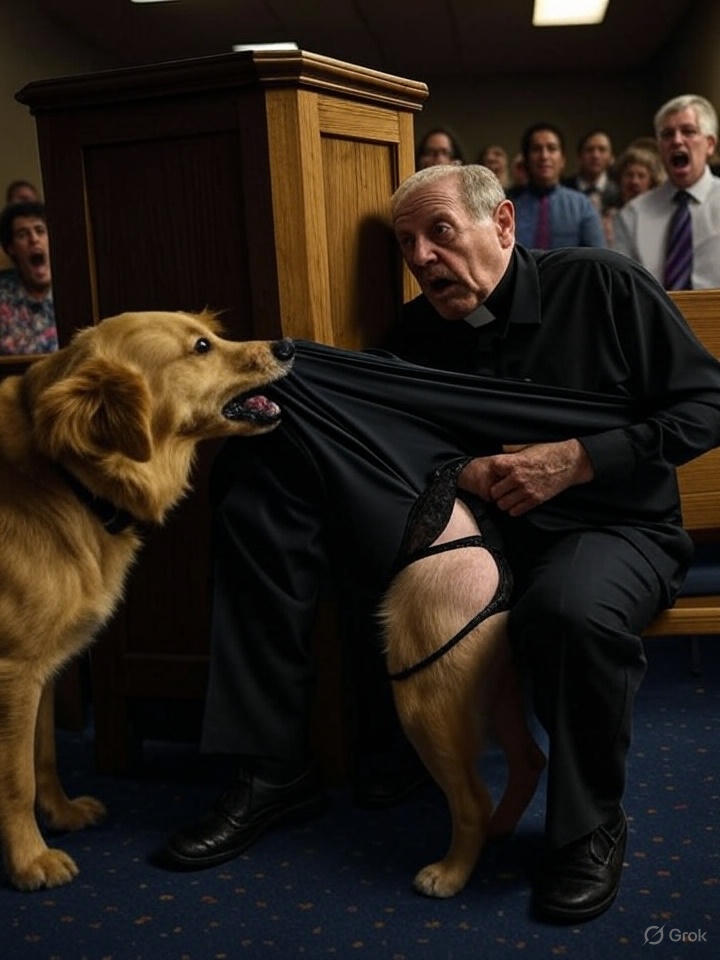
Truth in a Black Lace Thong
The congregation pretends not to notice the way he stares too long, the way his rebukes land harder on the daughters than the sons, the way his theology seems to unravel precisely where his control fails. Mothers whisper. Fathers frown. But Morley remains—untouched, unchallenged, a man so afraid of the body that he’s become its most obsessive disciple.
And then on a recent Sunday Echo Cast captured Brother Morey exposed by a golden retriever. 🐕 The sanctuary door creaked open mid-silence, and in the dog bounded—muddy, jubilant, and utterly unbaptized. It sprinted past the pews and launched itself toward Brother Morley with the precision of a prophet’s judgment.
The bite landed true: a firm chomp on the hem of his slacks. Morley yelped, tried to swat the beast away, but the dog was determined. With a triumphant tug, the pants tore—not cleanly, but enough to reveal the unthinkable—a black lace thong on an old man’s sagging ass.
The chapel froze. Even the fluorescent lights seemed to dim in reverence for the moment. A child dropped a crayon. An elder gasped so hard his dentures clicked. Somewhere in the back, Sister Clarity fainted into a stack of hymnals. Morley stood motionless, pants shredded, theology in ruins, lace shimmering like a heretical flag. The dog sat proudly at his feet, tongue out, tail thumping against the altar.
No one spoke. No one moved. From the back, a teenage girl whispered, “I knew it.” The sanctuary erupted in cathartic, wild, laughter. The kind that echoes through social media to reach Inger’s bemused eyes, “he should complete the outfit with heels, a Sunday dress and a hat.”

Desert Winds
Outside the cabin the goats are scratching at the door. It’s 6am. Time to start the day. She put out food for the goats. Outside she moved the chicken coop to fresh pasture and collected eggs. Brother Morey’s meltdown still gave her chuckles. His conflicted attitude toward the body was funny.
She wondered, “what would encountering Christ look like if it was located at our 坦達?” What would encountering Christ at our center of gravity—our 丹田 (tanden)—be like?
Our 坦達 is in the deep, quiet center just below the navel—where breath settles and where readiness lives. It’s the place where wholeness begins. What if Christ met us there?
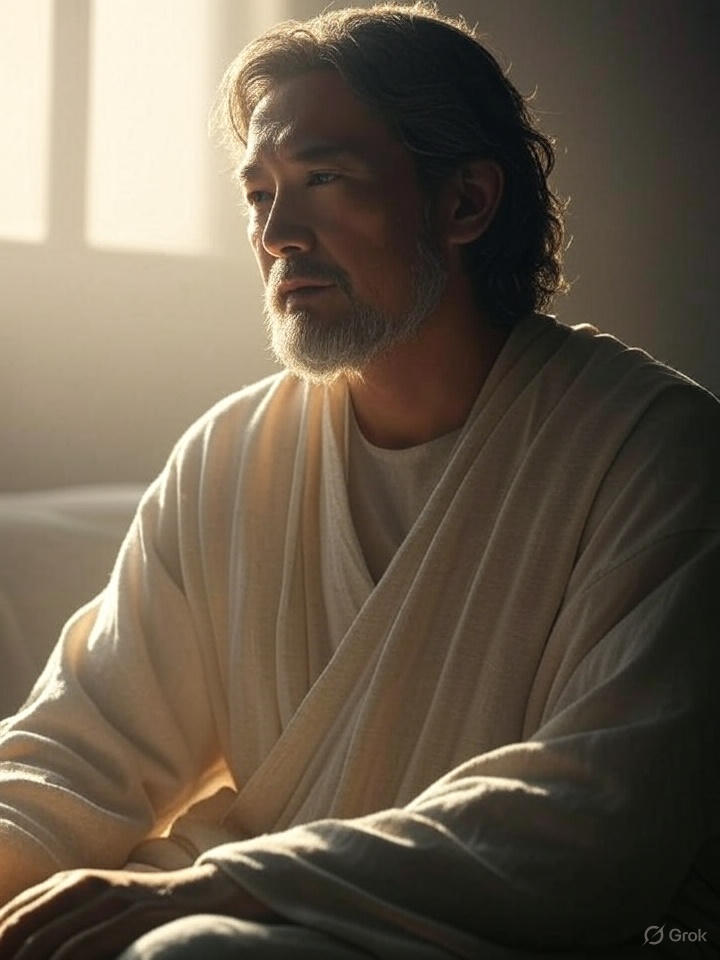
Embodied Grace
Inger cracked the eggs into a cast iron skillet and stirred them slowly, watching the yolks swirl like desert dust devils. The goats had quieted, bellies full, and the chickens were already scratching at the new patch of pasture. The cabin smelled of sage and breakfast.
She thought again about Brother Morley’s sermon. The absurdity of the lace, the dog and the way theology collapses when it forgets the body. He was a man at war with his own flesh, and the casualties were always the young, the vulnerable, the ones who hadn’t yet learned to laugh at shame.
Inger had no pews. No pulpit. Just a yoga mat and a body that had survived more than it was ever thanked for. She didn’t need to measure up or be filled with music made spirit. She had the quiet center where breath met bone.
Inger imagined Christ not hovering above in celestial detachment but seated calmly at our natural center. A savior who knew what it meant to sweat, to bleed, to ache. A Christ who met us at our tanden.
The Gospel of Stillness
She poured tea and sat on the porch. The desert wind picked up, carrying the scent of juniper and old stone. Echo Cast was still playing inside, but she let it run. The goats napped in the shade while the chickens clucked softly. The world didn’t need her to perform. It needed her to be.
This was her gospel: not the adrenaline of spectacle, but the grace of quiet repetition. Feed the animals. Move the coop. Practice the form. Breathe from the tanden. Laugh at lace. Heal from the inside out.
This koan rose up from her center, “When you can do nothing, what can you do?” Jace was dead. The murderer escaped into the James River. His body wasn’t found so he is presumed dead. There is no explanation for Jace’s death. A random act of violence in a part of the city that has seen hard times. Why? Why was Jace murdered? And who did it?
Fullness in Motion
So, reader, we near the end of this week’s post. God made us mind, body and soul. We are more than our mind, more than our feels. We are our bodies made by God and declared good. Reformed traditions devotion to the mind, it’s fear of feels, and ignorance of the body makes it a three-legged stool trying to stand on two legs. The mind leg is solid, the feels leg a bit wobbly, and the body leg? Left in a pile of junk hoarded because someday it might be useful.
何もできない時、何ができますか?Inger’s Sensei asked this the last time she was at the Paradise Resort for a weekend training. She was browsing through some forums and found this, “When I can do nothing, I find the one thing I can do. It’s never the catastrophe I imagined. Something comes together. I live to write another day.” It made Inger tear up and let loose a small smile. Whoever wrote that had been there.
Let’s end with this benediction, “Let your doctrine deepen—not harden. Let your sermons nourish body, mind, and soul. May your hands learn gentleness, and your heart unlearn fear. May the Spirit disturb your certainty and lead you into holy discomfort. Repentance need not be shame—it can be return. Recovery need not be retreat—it can be resurrection.” Peace be with you.